
Mazdutide
-
Detail
Maz Overview
Maz is a novel long-acting dual agonist of the glucagon-like peptide-1 receptor (GLP-1R) and the glucagon receptor (GCGR), offering diverse mechanisms of action and significant therapeutic efficacy. On one hand, by activating GLP-1R, it promotes insulin secretion and inhibits glucagon release in a glucose-dependent manner, while slowing gastric emptying and reducing appetite, thus efficiently regulating blood glucose levels. On the other hand, GCGR activation accelerates lipolysis, enhances energy expenditure, and reduces hepatic fat accumulation, leading to prominent effects in weight management. Beyond these, Maz also plays a positive role in improving hyperuricemia, regulating blood pressure, and maintaining cardiovascular health, providing a promising new option for the treatment of type 2 metabolism, obesity, and related metabolic disorders.
Maz Structure
Sequence: AEGTFTSDVSSYLEGQAAKFIAWLVKGRG
Molecular Formula: C207H317N45O65
Molecular Weight: 4476g/mol
CAS Number: 2259884-03-0
PubChem CID: 167312357
Synonyms: GLXC-26803
Maz ResearchWhat is the research background of Maz?
The prominent issue of global obesity and related diseases:
Overweight and obesity have become increasingly severe global public health challenges. According to the World Obesity Atlas, the number of obese people globally reached 764 million in 2020 and is expected to rise to 1 billion by 2030. Obesity can trigger numerous health complications, such as cardiovascular diseases and type 2 metabolism, which seriously affect the individual's quality of life and global medical resources. This has driven researchers to explore effective treatment methods, especially new drugs.
The development foundation of incretin-based drugs:
Since the concept of incretin was proposed in 1932, related research has been steadily advancing. In 1987, GLP-1 was identified as a key regulator of insulin secretion in the pancreas, and treatment regimens for type 2 metabolism based on incretin were developed. In 2005, exenatide, the world's first GLP-1 receptor agonist (GLP-1RA), was approved for marketing, laying a solid theoretical and practical foundation for the research and development of new incretin-based drugs like Maz. Maz is an analog of mammalian oxyntomodulin (OXM). As a new-generation dual agonist targeting GLP-1R and GCGR, it has a unique dual-action mechanism and broad prospects in the treatment of weight loss and related diseases.
What is the mechanism of action of Maz?
Agonistic effect on the glucagon-like peptide-1 (GLP-1) receptor:
GLP-1 is an intestinal hormone that can promote insulin secretion and inhibit glucagon secretion in a glucose concentration-dependent manner, thereby reducing blood glucose levels [1]. As a GLP-1 receptor agonist, Maz mimics the action of GLP-1, enhancing insulin secretion and reducing glucagon release, which helps regulate blood glucose. Moreover, GLP-1 receptor agonists can delay gastric emptying, enhance satiety, and reduce food intake, which is beneficial for weight control [1, 2].
Agonistic effect on the glucagon receptor:
Glucagon can promote the breakdown of liver glycogen and gluconeogenesis, leading to an increase in blood glucose. Maz, by activating the glucagon receptor, can regulate multiple aspects of glucose metabolism, achieving fine regulation of blood glucose. Glucagon also promotes lipolysis, helping to reduce fat accumulation and lower body weight [1, 2].
Regulatory effect on blood pressure:
Maz can reduce both systolic and diastolic blood pressure. On the one hand, it lowers blood pressure by regulating glucose and lipid metabolism and improving vascular endothelial function; on the other hand, it may affect blood pressure regulation mechanisms such as the renin-angiotensin system.
What is the specific mechanism of Maz for weight loss?
Regulation of blood glucose and metabolism:
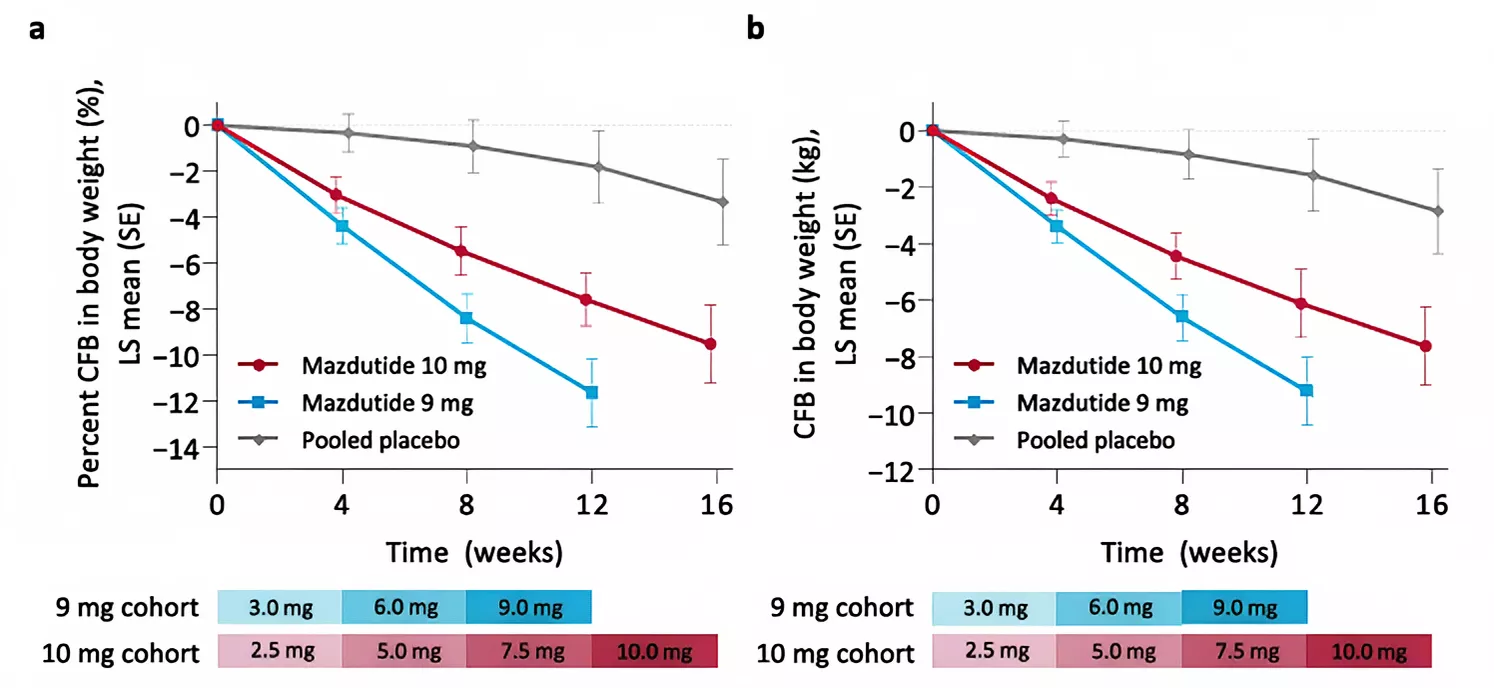
As a dual agonist of the glucagon-like peptide-1 (GLP-1) and glucagon receptors, one of the multiple physiological effects of GLP-1 is to regulate blood glucose levels. It promotes insulin secretion, inhibits glucagon secretion, reduces blood glucose[1], delays gastric emptying, increases satiety, and reduces food intake. Glucagon, on the other hand, promotes lipolysis and energy consumption. Therefore, Maz activates both receptors and regulates blood glucose metabolism to achieve weight loss. Studies have shown that Maz can reduce body weight, blood pressure (systolic and diastolic), total cholesterol, triglycerides, low-density lipoprotein, and high-density lipoprotein levels[3], indicating that it can lead to weight loss and improve obesity-related metabolic disorders.
Influence on appetite and energy intake:
Maz may achieve weight loss by influencing appetite and energy intake. In some clinical trials, participants experienced gastrointestinal reactions such as decreased appetite after using Maz[3]. This may be caused by the direct action of Maz on the gastrointestinal tract or through regulation by the central nervous system. Regardless of the mechanism, decreased appetite and gastrointestinal side effects will reduce energy intake and promote weight loss. In addition, Maz may affect appetite by regulating neurotransmitters and hormones in the brain. For example, GLP-1 can act on the hypothalamus to regulate appetite and energy balance[4].
What are the specific action pathways of Maz in regulating blood glucose?
Stimulation of insulin secretion:
Glucagon-like peptide-1 (GLP-1) receptor agonists can stimulate insulin secretion. As a dual agonist of GLP-1 and glucagon receptors, Maz may activate the GLP-1 receptor to prompt pancreatic islet β cells to secrete insulin. Insulin is a key hormone for reducing blood glucose, which can promote cells to take up glucose and lower blood glucose levels[1].
Inhibition of glucagon secretion:
At the same time, Maz may act on the glucagon receptor to inhibit glucagon secretion. Glucagon and insulin are antagonistic to each other in blood glucose regulation, and reducing its secretion is conducive to lowering blood glucose[1].
Regulation of glucose metabolism:
Maz may regulate glucose metabolism at multiple levels to exert its hypoglycemic effect, such as affecting the glucose metabolism in the liver, muscle, and adipose tissues. In the liver, it reduces the breakdown of liver glycogen and gluconeogenesis, decreasing the production of blood glucose; in muscle tissue, it promotes the uptake and utilization of glucose; in adipose tissue, it regulates lipid metabolism, reduces the release of free fatty acids, and indirectly affects blood glucose[1, 3].
Influence on appetite and energy intake:
Studies have found that Maz can reduce appetite and energy intake, possibly by acting on receptors in the central nervous system and regulating the appetite signaling pathway. Reducing food intake can lower the source of blood glucose and help control blood glucose levels[3, 5].
-
Customer ReviewsNo comments